How to efficiently machine shaped parts on CNC mill-turn machines?


With the rapid development of aviation technology, the performance requirements for aviation products are becoming increasingly stringent.
Manufacturers increasingly adopt integrated components, making parts structures more complex.
Consequently, the surface quality and machining precision requirements for aviation products are also becoming more stringent.
Traditional mechanical manufacturing methods can no longer meet the development needs of the modern aviation industry.
The aviation manufacturing industry is increasingly applying high-speed cutting technology for its high processing efficiency and excellent surface quality.
This paper uses an embedded seal cover as an example.
It illustrates the practical application of high-speed cutting technology in the aviation manufacturing industry.
The embedded sealing cover serves as a load-bearing structural component.
Its product quality directly impacts the overall load-bearing capacity of the structure.
To ensure the overall strength of the component, the machining accuracy and surface quality of the part play a crucial role.
The designer selected 7050 aluminum alloy sheet for the part, as it is a high-strength heat-treatable alloy.
It possesses extremely high strength, resistance to exfoliation corrosion, and resistance to stress corrosion cracking.
These properties make it particularly suitable for manufacturing structural components and other high-stress structures requiring high strength and corrosion resistance.
Figure 1 shows that the embedded seal cover part has outer contour dimensions of 150 mm × 150 mm × 900 mm, with a material thickness of δ = 160 mm.
Multiple ribs, cavities, and irregular recessed areas cover the part’s exterior.
They are unevenly distributed across the inner and outer surfaces, weakening its structural integrity.
The part’s edge strips and shell surface have closed-angle regions with a significant area. The thickness of the part’s ribs ranges from 1.5 to 6 mm.

We analyze the processing challenges of the part as follows.
1. Due to the part’s structural characteristics, the material removal rate during overall processing reaches up to 90%.
This severely disrupts the internal stress balance of the material, making deformation highly likely.
2. Since the material thickness is 160 mm, long tools with a length-to-diameter ratio greater than five must be extensively used during actual machining.
If the cutting force is too high, severe chatter will occur, significantly affecting the surface quality of the part.
3. The minimum rib thickness inside the shell cavity is 1.5mm, with a rib height of 28mm, classified as a high-thin rib type.
Due to the weak strength of the ribs, deformation is likely to occur during machining, leading to dimensional deviations and subsequent scrap of the part.
4. Extensive closed angles and irregular recessed areas on the housing’s exterior significantly increase programming complexity.
They also increase the workload required to remove closed-angle residues.
5. Due to the large outer dimensions and complex structure of the part, the overall machining cycle is lengthy.
Therefore, reducing the machining cycle and improving machining efficiency are particularly important.
High-speed cutting technology offers the following advantages.
Compared to conventional cutting, high-speed cutting reduces cutting forces by over 30%.
This reduction is significant for minimizing part deformation, especially for parts with poor rigidity.
This enables precision finishing and thin-wall processing of workpieces, ensuring high processing accuracy.
During high-speed machining, chips are ejected at extremely high speeds.
The chips carry away most of the heat generated during machining, significantly reducing the heat transferred to the workpiece.
This also greatly reduces thermal stress during the machining process, minimizing part deformation and enhancing machining accuracy.
Increasing the cutting speed moves the operating frequency of the entire cutting system away from the machine tool’s natural frequency.
This avoids resonance that could affect surface roughness.
It also effectively suppresses the formation of built-up edges, preventing them from affecting the machined surface of the part, thereby improving surface quality.
Generally, the feed rate in high-speed cutting is 5–10 times that of conventional cutting.
As cutting speed increases, the material removal rate per unit time rises, cutting time decreases, and machining efficiency improves significantly.
This achieves the goal of shortening the machining cycle.
Since the cutting force in high-speed cutting is relatively small, tool wear is minimal, significantly extending tool life.
Additionally, the enhanced processing efficiency of high-speed cutting also significantly improves the utilization rate of CNC equipment.
Selecting high-speed cutting as the processing method for CNC machining of the internal sealed cover is the optimal choice for our factory at present.
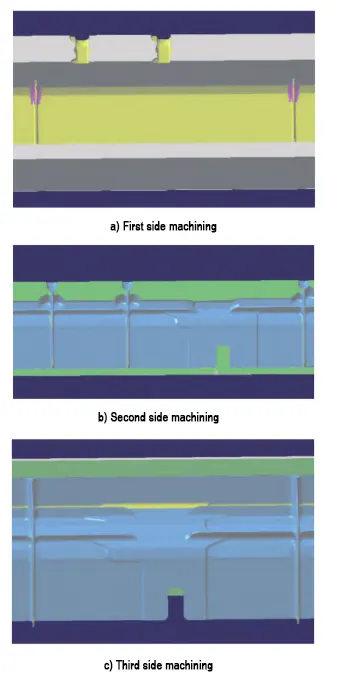
Given the material properties and structural characteristics of the part, we employ a pressure plate clamping method for three-sided machining.
Machinists prioritize machining the shell’s inner cavity first because it has the most significant metal removal volume, suffers the most severe internal stress damage and part deformation, and contains the part’s thinnest rib.
Machining the thin rib to the required dimensions on the first side ensures the part achieves its optimal overall strength.
Before processing the second surface, the blank undergoes stress-relief treatment to release internal stresses manually.
After the blank has fully deformed, the part’s machining origin is recalibrated, and the second surface is processed.
Compared to the outer shape of the third surface, the second surface lacks two ribs approximately 900mm long, resulting in lower structural strength.
Therefore, machinists prioritize processing this area.
When machining the third surface, operators must carefully consider the reserved positions of the connecting ribs.
This ensures the strength requirements are met and allows conventional operators to remove the part easily.
Machinists first machine the inner shape of the shell cavity and then cut off the part during the final machining of the outer shape.
Throughout the machining process, operators select small cutting parameters—reducing axial cutting depth and appropriately increasing radial cutting depth—and maintain high feed rates.
This ensures uniform high-speed cutting of the part while minimizing the impact of cutting forces on surface quality.
The CNC machining process for the internal sealed cover is shown in Figure 2.
After the actual production and processing were completed, the parts exhibited certain quality defects, primarily manifesting in three aspects:
1. The outer surface of the housing exhibits noticeable vibration marks.
2. A 45° angle rib approximately 640mm long on the outer contour of the housing exhibits a “misalignment” phenomenon.
3. The surface of the ribs with a thickness of 1.5mm inside the housing cavity exhibits noticeable vibration marks.
The causal analysis is as follows.
1. During the machining of the outer surface of the housing, the inner cavity of the housing had already been fully machined, resulting in a housing thickness of only 4mm.
However, the entire outer surface of the housing is approximately 900mm in length, leading to insufficient part strength.
The cutting force generated by the rotating tool caused the housing to vibrate vertically along the axial direction during machining, resulting in vibration marks.
2. The outer shape of the 45° angled ribs on the shell’s exterior was machined in two separate workstations.
Operator positioning errors, machine tool system errors, and deformation from residual internal stress released during the part’s secondary clamping caused the outer shape of the angled ribs to misalign.
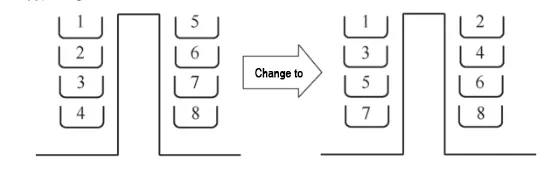
3. When machining 1.5mm-thick ribs, the programming scheme involves fully machining one side of the rib’s outer shape before performing precision machining on the other side.
Due to the rib’s thin thickness and poor strength, elastic deformation occurs during precision machining of the other side, leading to the formation of vibration marks.
We implemented the following solutions to address the processing issues encountered.
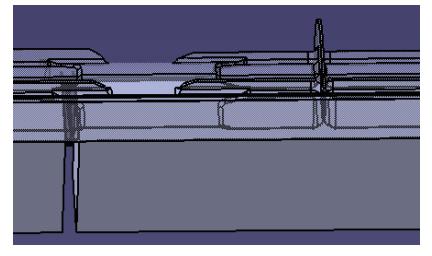
1. We fabricated three auxiliary supports to reinforce the shell’s inner cavity during contour processing.
This enhanced shell strength and prevented vibration marks.
The fabrication of the three auxiliary supports is illustrated in Figure 3.
2. Adopt the principle of unified reference points to complete the precision machining of the 45° angle ribs on the shell’s outer shape at the same workstation.
3. Modify the programming scheme for the 1.5mm ribs, changing the original single-sided precision machining to a tool ring-cutting method (see Figure 4), and precision machining on both sides simultaneously.
After adopting the new CNC machining plan, the parts’ overall machining condition improved.
The shell surface shows no chatter marks, and machining accuracy meets design requirements, ensuring product quality.
This paper introduces the structural characteristics of the housing for the internal sealed cover part and the CNC machining scheme.
It highlights the advantages of high-speed cutting technology.
Through subsequent process improvements, engineers resolved issues like surface chatter marks on the housing exterior and misaligned ribs.
They also summarized a practical high-speed milling method.
As an advanced manufacturing technology, high-speed cutting not only improves product machining accuracy but also enhances surface quality.
It offers vast application prospects in the rapidly developing aerospace manufacturing industry.